Important Practices for Visual Creativity
[Part 1] Getting started

All perceiving is also thinking, all reasoning is also intuition, all observation is also invention.
Rudolph Arnheim
Why do we make pictures?
In our 5-part series - Important Practices for Visual Creativity, we address how to approach our development as artists in a practical, positive way. In this first instalment we focus on what’s useful to think about when getting started (or restarted) in drawing, painting and related visual arts.
Artists make pictures for all kinds of reasons, but I’d like to propose that the ones that will keep you going for the longest (and maybe keep you the happiest) are to do with curiosity (what happens if I try this?), the joy of creation as an activity and the pleasure of looking.
I’ve been drawing a lot my whole life and it’s been a key part of how I make my living so there have been some other rewards but I think the main thing, the thing that’s most consistently given me pleasure is that once I’ve drawn a scene, subject or object I see it more clearly and it’s in my brain much more securely.
These things are subjective and vary between people — I’m not criticizing artists who have some specific goal in mind, but in our learning, I think appreciating how our drawings can surprise and teach us is really helpful. Seeing the process of looking as practising a form of intelligence that needs to be nurtured can give great benefits and, to me, is at the heart of the matter.
How to start making pictures...
On a practical level I really believe it’s worth trying different materials and that humble materials can give great results. In our early coursework we mostly just work with soft pencils and maybe a fineliner or pen on cheap paper (or a drawing tablet if that suits the student better) but in advance of any art making I would suggest you collect whatever art materials you may have (or the art materials from some family members if they don’t mind) and try different pencils, pens and papers to do quick studies or tests or even just try making marks, that way when you hit a proper challenge you will know how your tools will behave and what works well with your hand.
In general, if you are just getting into drawing practice it’s good to start monochrome, but that could be a colour and doesn’t have to be black – it should just be easy to get a line or mark with a gentle pressure so that you don’t have to be sweating away to build your drawing. Also not too thick or fine a line as you will want to be able to finish quick sketches with a moderate amount of detail, probably at A5 or A4 size.
It’s good to have your drawing materials together, ready to go so that if you have some time or energy, you can get started quickly. As a young adult I hit a patch where I hadn’t been drawing for a long time, I realized that I missed it and wanted to get back into it. For me, anyway, all it took was leaving a ream of copy paper and some nice-ish pens from the CNA on my table and I was drawing every night after work again.
There will be other challenges but try to make it easy for yourself to get started, if you can’t reserve a regular spot to draw, get a clipboard and have a bag with your things so you can find somewhere to sit (or stand) and work for a bit.
While we are on it, I do believe in regular but not super long sessions when you are getting into it, often half an hour a couple of times a week is enough to make progress. For myself I like to have sessions from 1 hour to 4 hours to get a lot done, recognizing that of that time not all of it can be highly focussed – there will be bursts and then my brain gets fried and will need to rest a bit.
Part of what you will be learning at first is what kind of a session fits you best – time of day can also be a key factor.
Learning as an artist and some principles for a positive approach to your visual practice
Navigating through the process of developing your art you can feel like you are getting battered by the winds. The process can be challenging anyway but in this digital age, the sheer amount of art and the number of art resources can be overwhelming. At various points in your artistic development, it can be challenging to decide what to focus on and which artistic path to pursue. It certainly can be intimidating to see all the great work being done out there.
To have dreams of some artistic future is perfectly valid and good but we should distinguish between these and the actual practising of our skills and development of our art and craft.
In truth we don’t know what our art will look like in future and that journey of discovery is likely the whole point.
There might be certain skills we want to develop, or some style or technique we want to explore, and we can focus on those absolutely but, for me anyway, it’s the change in our perceptions – the ability to see in new ways that is most exciting about learning in the visual arts.
In my experience, awareness of this kind of perceptual changing and seeing that as the real research usually results in artwork getting stronger faster. Be aware that as your artwork develops so will your critical faculty so you may struggle to see progress, this is why it’s important to keep or record your old work – to track that progress.
Here are some principles I like to try and use in class and for myself:
Patience – be kind to yourself and accept that some learning takes time
Humility – be open to learning and especially being okay with trying a different way
Discipline – accept that many of the skills we need require regular practice and warmups
Hopefulness – never say I can’t do it, (maybe just not yet)
Have faith in yourself that you can find a way
The Important Questions to Ask
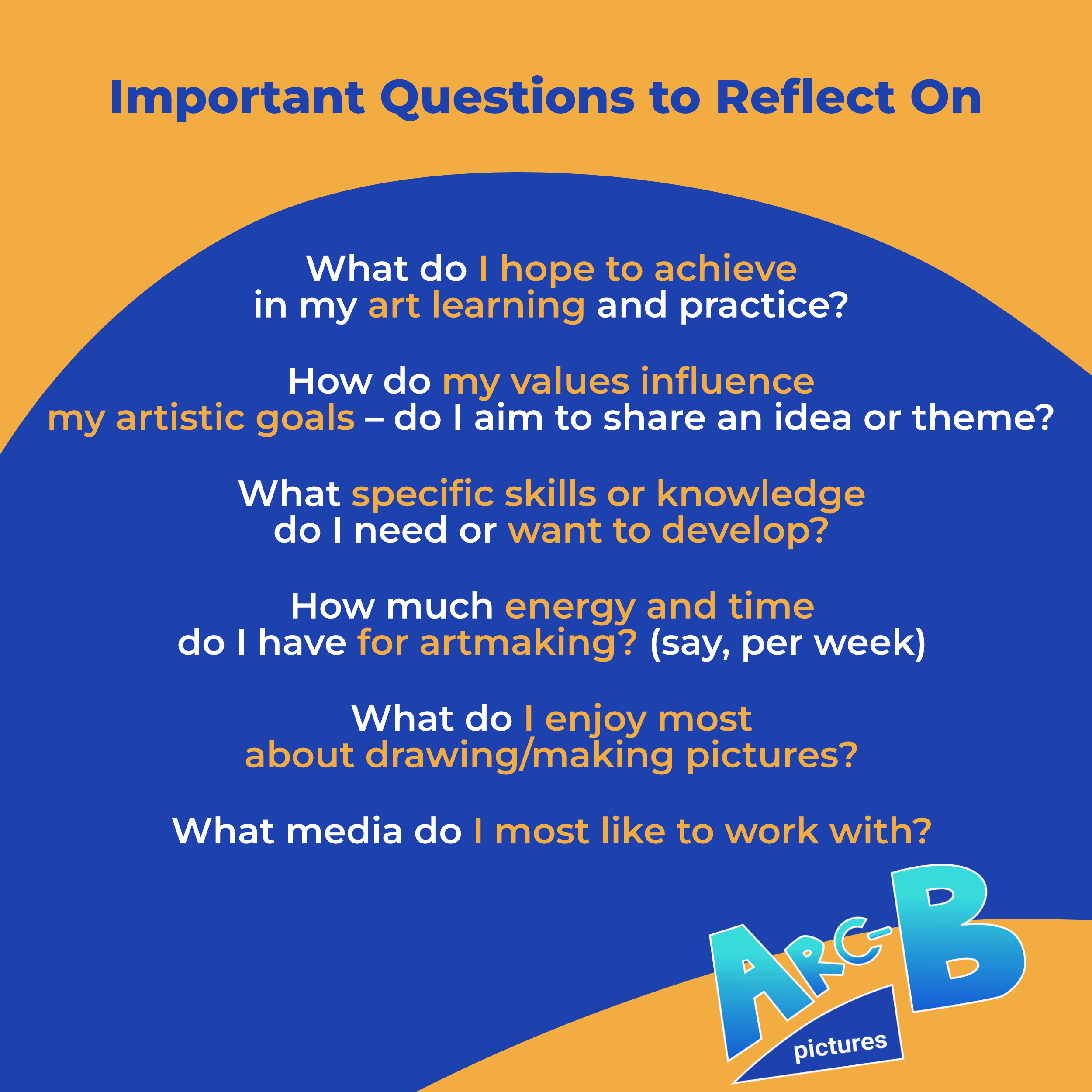
The key to life's journey is knowing what you want and where you want to go. These will evolve as your career and passions develop. It's crucial to experiment, particularly in a creative field, to explore possibilities and draw from various sources, ultimately crafting your unique artistic path. To start engaging with this process below are some important questions you might not be able to answer immediately but are worth reflecting on nonetheless:
Who is Your Mentor?
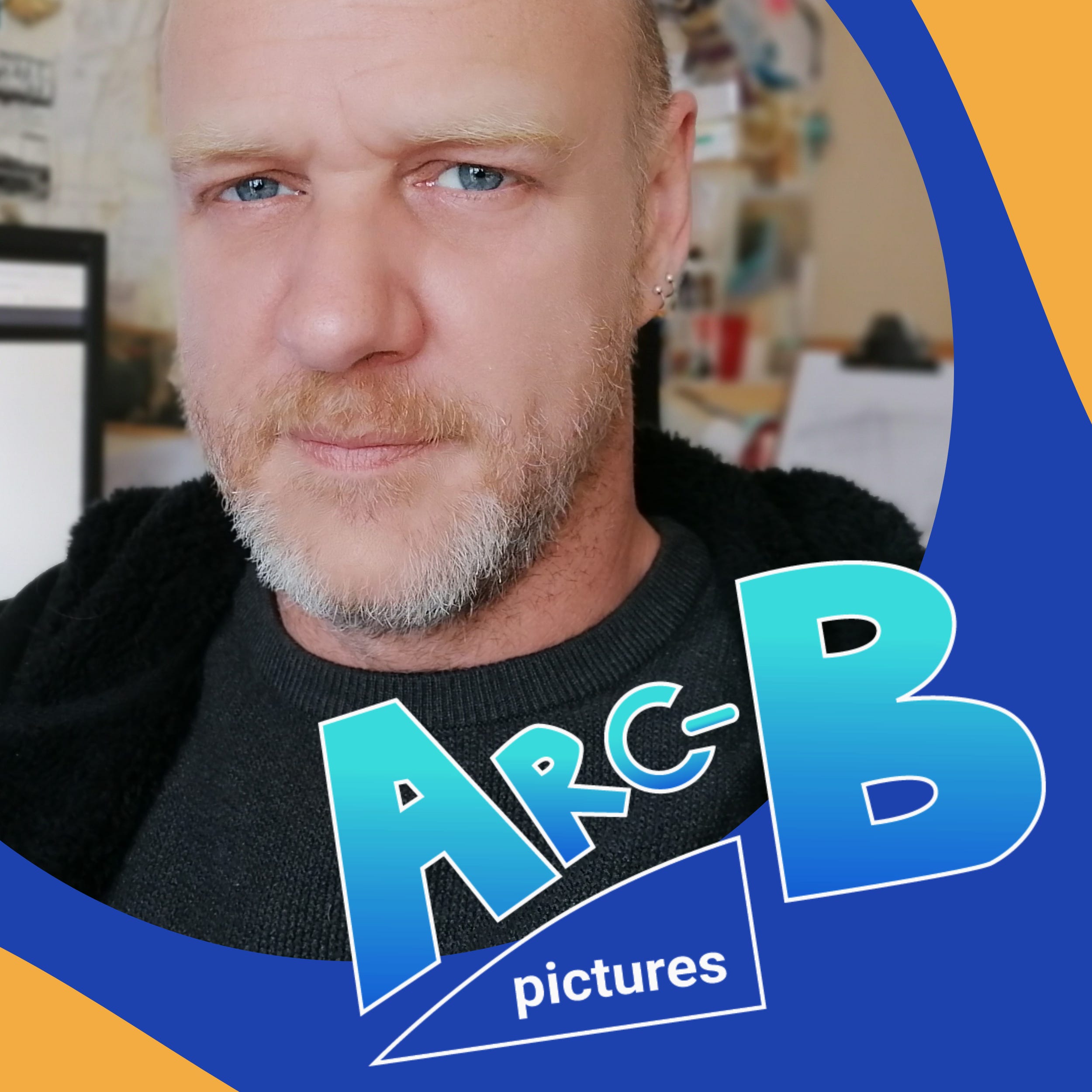
Archie Birch is the owner of Arc-B Pictures. He studied first at the Michaelis School of Fine Art in Cape Town, South Africa back in the 90s and then earned his Masters in Illustration at the Stellenbosch University Art Department a decade later.
Archie has worked as an illustrator, animator and filmmaker for 25 years or so but has also spent a lot of that time teaching South African and International students. These students have ranged from fine arts to comic book artists, illustrators, storyboard artists, and artists and animators in the film and gaming industries.

“I met Archie through the Triggerfish Academy Storyboarding course where he was my lecturer. He has given me more than the power to draw, he gave me confidence as an artist.” ~ Gigi
Vote in Our Poll. Your Opinion Matters!

Happy Drawing! Remember, practice makes perfect. Share your progress with us using @arcb.pictures and stay tuned for news on courses, draw-along sessions, and awesome drawing content!

If you are ready to learn more, sign up for our full 8-week mentorship with Archie Birch. Level up your drawing now. Seats are limited and the mentorship works on a first come first serve basis.